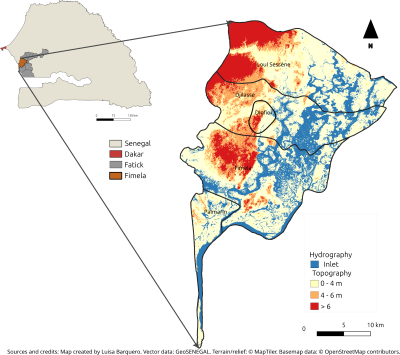
In Senegal, in the district of Fimela (Sine Saloum), the absence of surface freshwater streams makes local populations dependent on freshwater lenses that are recharged by rainfall and tapped through hand dug wells.
These lenses are vulnerable to salinization because their volume and stability decrease when recharge declines (reduced rainfall, increased evapotranspiration) and withdrawals increase. As the lens thins, it becomes more exposed to saline inputs, in particular through intrusion from the underlying saline groundwater and through the transfer of salinity from shallow salt affected soils, locally known as tannes.
This research is based on an interdisciplinary approach aimed at characterizing how freshwater lenses function, their spatiotemporal variability, and their vulnerability. The hydrogeological component combines geophysical imaging, monitoring of the physical and chemical properties of the water (pressure, temperature, conductivity), and chemical analyses in order to constrain the state of the lenses, their evolution over time, and salinity gradients.The sociohydrological component feeds into the Fimela Living Lab through interviews and field observations, with the aim of documenting water uses and identifying the drivers of groundwater withdrawals.
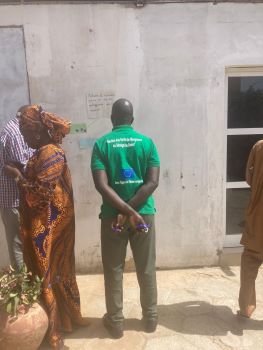 © Photo Luisa Barquero
In parallel, the research mobilizes companion modelling, including forum theatre and multi agent models, to co produce with stakeholders shared representations of water dynamics and water uses.
The overall aim of this work is to support territorial reflection on participatory water management options that are adapted to the local context.
Key words: freshwater lenses, salinization, Fimela, geophysics, hydrogeochemistry, Living Lab, participation